Every hair transplant depends on one limited resource: the donor area. These are the follicles at the back and sides of the head that are genetically resistant to balding. For most patients, the donor area is enough. But for people with very advanced hair loss, or those who have already had transplants, it may not be. Understanding how donor hair works, and what alternatives exist, is essential for realistic planning.
What Makes a Good Donor Area?
The hair on the back and sides of the scalp usually keeps growing even when the top of the head becomes bald. This is why it is used as the main source of grafts. A surgeon assesses the donor area by looking at:
- the number of follicular units per square centimetre
- how many hairs each graft contains
- hair thickness and texture
- the overall size of the safe donor zone
- signs of thinning that could spread in the future
Why over-harvesting is a risk
Every follicle removed from the donor area is gone for good. Taking too many grafts can leave the back of the head visibly thin and patchy. A responsible plan balances today’s result with the need to keep enough donor hair for the future.
How FUE Uses the Donor Area
With the FUE method, grafts are removed one by one with a small punch. Because extraction is spread evenly across the donor zone, the remaining hair hides the tiny extraction points once it grows back. FUE leaves no linear scar, which is one reason it has become the most widely used technique.
When the Scalp Is Not Enough: Body Hair
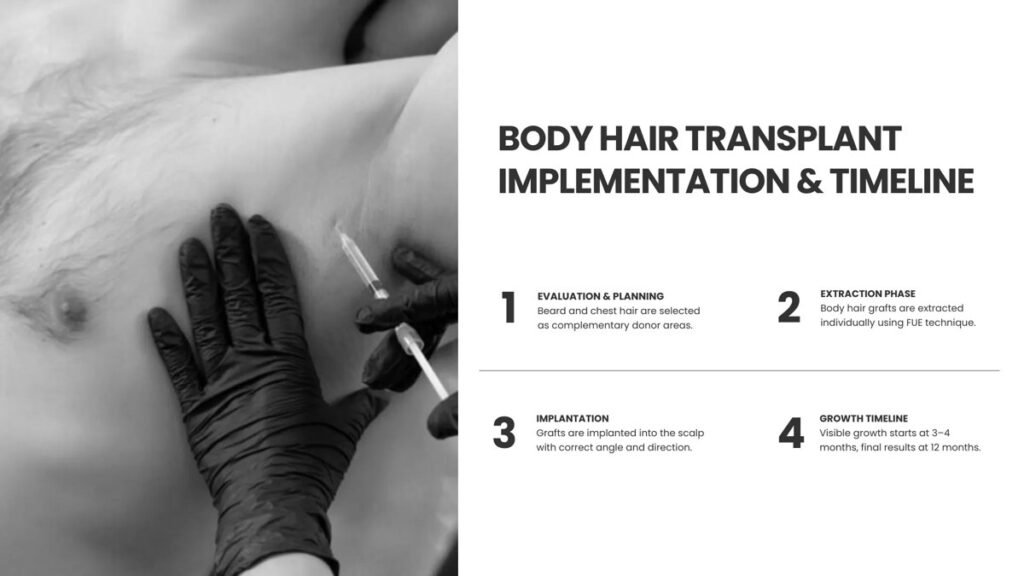
For some patients, scalp donor hair cannot provide all the grafts they need. In these cases, a body hair transplant may be considered. Follicles are taken from areas such as the chest using the same FUE extraction method and are then placed in the scalp, often to add density or to blend with scalp grafts.
Who may benefit from body hair
- patients with advanced hair loss and a limited scalp donor area
- people who have had previous transplants that used much of the donor zone
- those who need extra grafts to soften or camouflage scars
Limitations to understand
Body hair is different from scalp hair. It usually has a different texture, grows to a shorter length and often contains fewer hairs per graft. That is why it is typically used to complement scalp grafts rather than replace them. Growth also tends to take time: visible new hair usually appears after three to four months, with the final result after about twelve months.
Planning for the Long Term
Hair loss often continues after a transplant. A good surgeon plans the hairline and density with the future in mind, sometimes recommending medication to protect existing hair. This approach helps the result look natural for many years and avoids running out of donor hair if a second session is needed.

]
How Donor Supply Affects Cost
The cost of a hair transplant is closely linked to the number of grafts and the time the procedure takes. Body hair extraction is slower and more demanding than scalp extraction, so plans that include body hair are usually priced after a detailed assessment. Packages in Turkey are commonly all-inclusive, covering the procedure, accommodation, transfers and aftercare.
Questions to ask during your consultation
- How many grafts can my donor area safely provide?
- Will I need body hair, now or in the future?
- How will the plan protect my donor area for later?
- Who performs the extraction, and in what kind of facility?
Conclusion
The donor area is the foundation of every hair transplant. Protecting it, using it wisely and knowing when body hair can help are key parts of a good plan. With an honest assessment and a long-term view, even patients with advanced hair loss can find a realistic path to a natural result.